
Pigeon commercial electric cooktops
Savings Calculator for Pigeon Electric Cooktop
Pick your cooktop, tell us how much gas you use, and see what you save every month.
What you save
▸See the full working
The two cooktops
Two cooktops, one job: cook the same food for less.
Both are heavy-duty 3,500 watt commercial cooktops. The only real difference is how they make heat, and which pots they take.
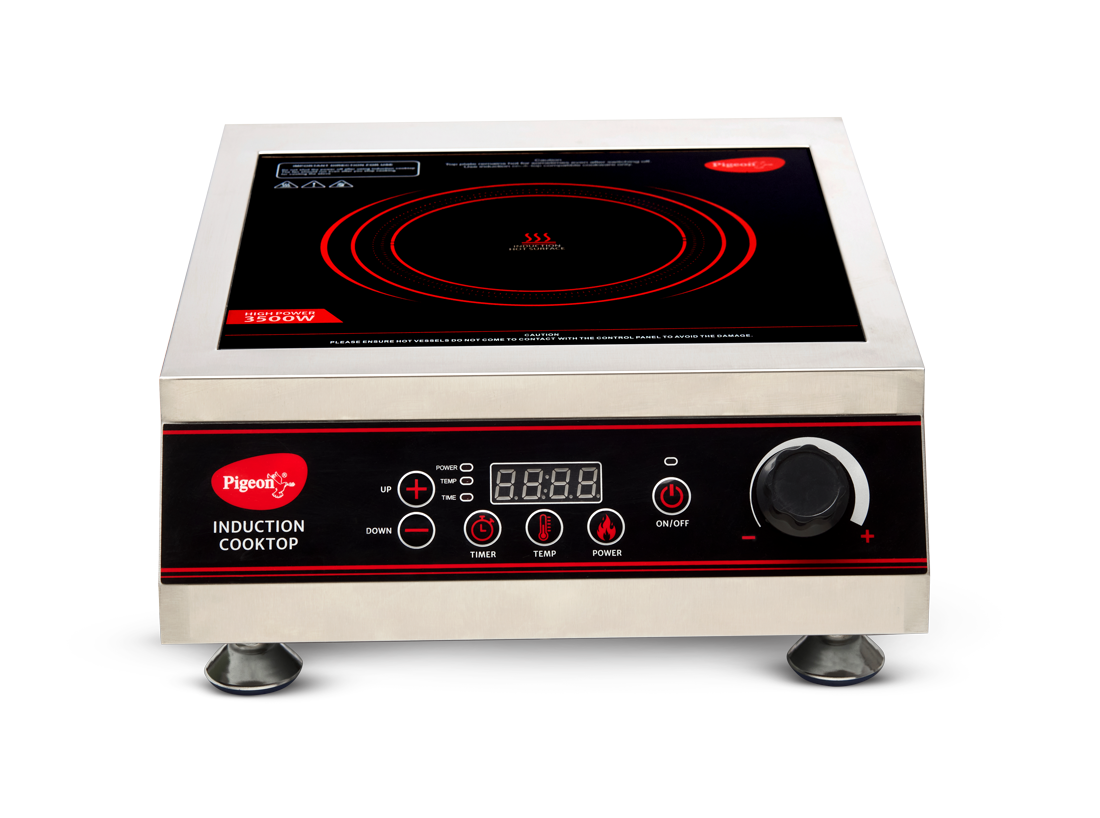
Infrared
A heating element glows red under a tough professional grid crystal top, a bit like an electric coil. It works with any pot, pan, kadhai or handi you already use, so you buy nothing new. The easiest way to switch off gas.
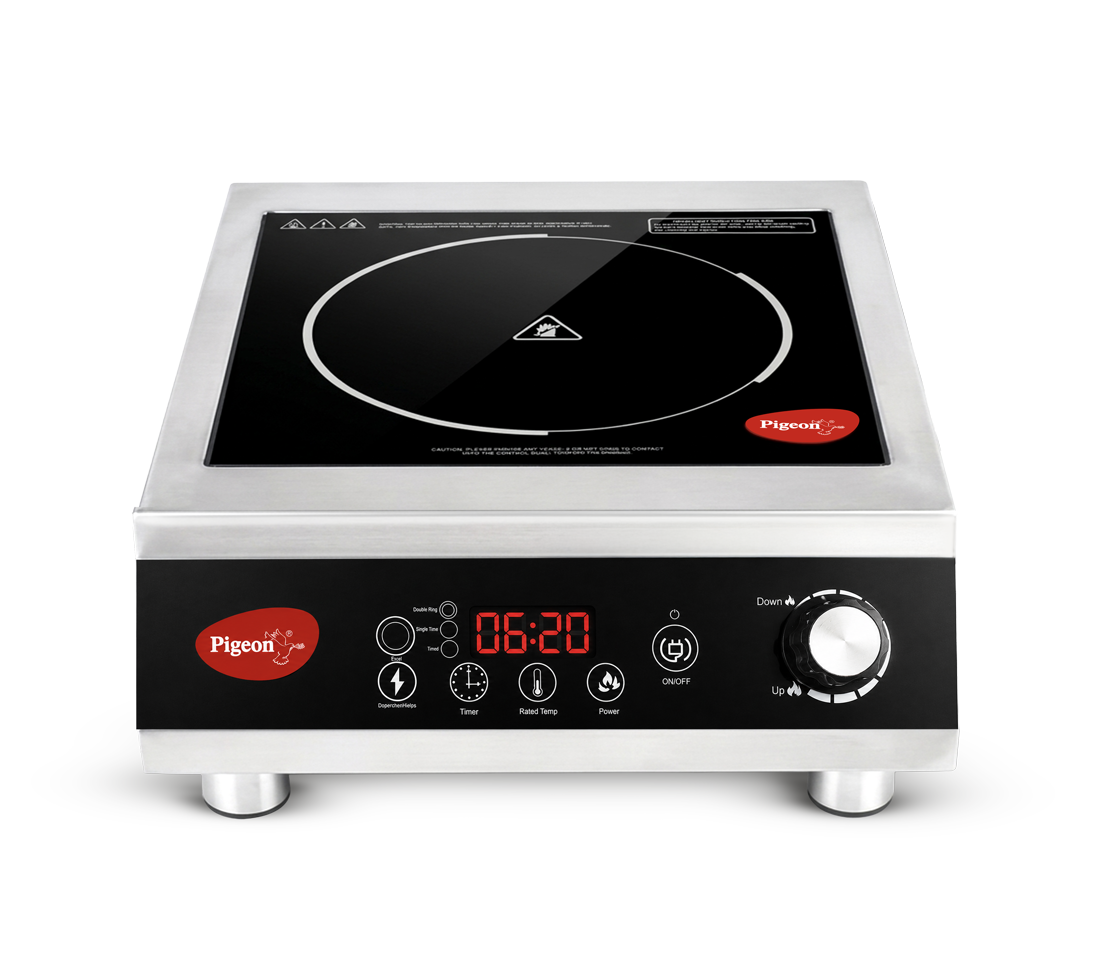
Induction
A magnetic field heats the vessel itself, so almost no heat is wasted. It is the most efficient and the cheapest to run, but it only works with flat, induction-ready cookware.
Every number, explained
Where each figure comes from.
| What it is | Value we use | Why |
|---|
Why 35% for the gas burner?
This is the number people question most. India's home-stove standard (BIS IS 4246) asks for 64% to 68%, but that is tested with a small pot on a domestic stove, so it does not describe a commercial kitchen. Here the burner is the high-pressure type used in a darshini, dhaba or cloud kitchen, running under 20 to 40 litre vessels with an open flame. Published measurements put those big burners at 30% to 40%, and ordinary burners at about 48% to 52%. So 35% sits at the lower-middle of the real commercial range.
Same cooking, measured fairly
We compare the heat that actually reaches the food, measured in units (kWh), not the raw fuel bought. Electricity is sized to that heat, so a more efficient cooktop draws less.
The claim says "up to"
Figures are per cooktop and scale with how much gas you replace. The percentage and per-cylinder saving hold at any usage; the monthly rupee figure grows with your gas use.
We rounded against ourselves
Each cooktop is charged a full ₹455 monthly connection fee, and we assume gas never gets dearer. Savings on kitchen cooling, storage, handling, safety and delivery delays are left out.
- Commercial gas prices: IOC, BPCL and HPCL commercial 19 kg bulletin, May 2026.
- Energy content of LPG: 12.86 units (kWh) per kg, the industry standard.
- Commercial burner efficiency 30% to 40% for 5 to 10 kW burners, about 48% to 52% for ordinary burners (IJIRSET; Energy 2020; experimental and numerical studies).
- Halogen infrared efficiency 60% to 75%; commercial induction efficiency 80% to 90% (industry-published ranges).
- Commercial electricity rate and connection fee: Karnataka, plus comparable Delhi and Maharashtra commercial tariffs.